The short answer: buy or configure existing software when it covers your critical workflow with acceptable trade-offs. Explore a custom build when repeated workarounds, special permissions, data movement, or process-specific rules are central to how your business operates.
1. Document the real process before comparing products
Pick one common transaction—for example, a transport job from assignment to invoice—and map who enters data, approves it, reuses it, and checks it later. Highlight handovers between people and systems. A feature list on its own won't show where errors, waiting, or duplicated work accumulate.
- Record the trigger: what starts a job, order or approval?
- List the roles and permissions: who can view, edit, approve and reverse an action?
- Identify the source of truth: which record must remain correct if tools disagree?
- Mark the exceptions: special rates, offline work, regional languages and rejected requests.
- Trace the output: invoices, documents, management reports and audit history.
2. Compare buy, configure, integrate and build
| Approach | Often appropriate when | Ask before committing |
|---|---|---|
| Buy a standard product | Most users can follow established workflows without frequent exceptions. | Can we export our records? How do pricing tiers and access limits change? |
| Configure an existing platform | The core functions fit, but roles, forms and notifications need tailoring. | Which settings survive platform upgrades? Are custom fields supported? |
| Integrate current tools | Separate systems work well independently but cause duplicate entry between them. | Are stable APIs available? What happens when a sync fails? |
| Build a custom workflow | Unique rules and connected data are fundamental, with a team able to maintain the result. | Who owns the source and data? What are support, hosting and recovery plans? |
3. Compare total cost, not just the first invoice
For a realistic comparison, list software subscriptions, implementation, migration, user training, integrations, infrastructure, ongoing support, and future changes. Also estimate the manual administrative effort each option will require. Avoid treating a possible efficiency gain as a certain saving: validate it against your own baseline.
A custom project may involve a higher initial cost but better fit. An existing tool may be cheaper and faster to introduce. Neither is automatically preferable; the choice depends on requirements, ownership responsibilities and the life of the system.
4. An operational example: transport workflows
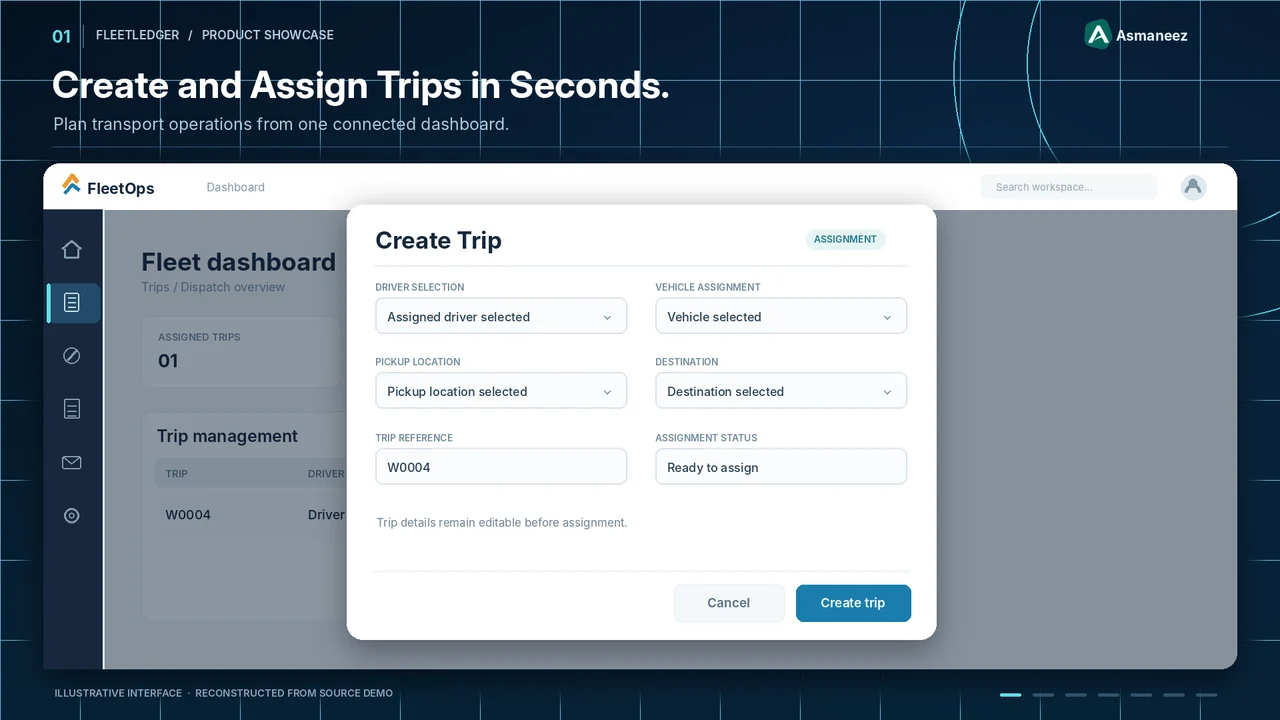
Asmaneez's FleetLedger case study describes a transport management workflow connecting trip assignment, driver activity, fuel, payroll and invoicing. Its project pages illustrate how a shared data flow can connect decisions that previously sat in different spreadsheets. This is one example of software scope—not proof of savings for another business.
5. Ask these five control questions
- Ownership: who has rights to the code, configuration, credentials and exported data?
- Continuity: how will backup, recovery and handover work if a vendor changes?
- Security: what access permissions, logging, encryption and review are required?
- Integration: which existing systems must still operate during and after rollout?
- Adoption: who will test, train and support people on the real workflow?
6. What to bring to a first scoping discussion
Bring two or three anonymized examples of a typical job or order, a list of roles, an approximate user count, the systems in use, and the decision you need to make next. Do not send patient records, passwords or sensitive documents through a generic marketing form. A small discovery exercise can rule out an unnecessary custom build.
Guide prepared by Asmaneez as a framework for procurement discussions; it is not a fixed-cost quote, security certification or guaranteed outcome.